Sewer and Water Line Excavation in Amherst
Key Takeaways: Digging and Backfilling in Lake-Plain Clay
- Repeat backups on the same run are the signal worth acting on: a lateral cleared twice inside a year is usually failing structurally, and a camera inspection settles that before any machine comes into the yard.
- Vitrified clay tile is common under the postwar streets in Amherst, and its mortared joints are the first thing that opens when the ground around them moves.
- Frost sets the depth. A sanitary lateral in this part of New York is buried well below the freeze line, so the trench runs deeper than the same repair would in a mild-winter market.
- Dense lake-plain silt and clay under Amherst sheds water slowly, so an open trench collects seepage and the walls need shoring while the work is in progress.
- Trenchless methods are conditional: pipe bursting and cured-in-place lining both need working access at each end and a host pipe that has held its alignment.
- Utility locating happens before the first bucket of soil comes out, with gas, electric, water and telecom marked and hand-dug where the path crosses them.
- Compaction is the part that lasts. Clay put back loose settles into a visible line across the lawn once a Western New York winter has worked on it.
- Roto-Rooter is fully licensed and insured, pulls the permit the work requires and arranges the inspection that closes the job out.
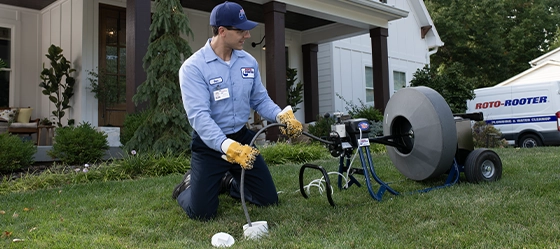
Amherst grew outward across the flat lake plain of Erie County, on silt and clay left behind by glacial meltwater, and the sanitary laterals under those front lawns have been sitting in that material ever since. When one of them finally fails, it seldom announces itself in a single dramatic moment.
How a Camera Inspection Decides That Excavation Is the Answer
Nobody in Amherst should be sold a dig on a description of symptoms. The line gets cleared, a camera goes down the same run, and the recording either shows a pipe that was sound and simply blocked or it shows a fault no cable can fix. That distinction is the whole decision, and it gets made on video the homeowner can watch.
Sewer line excavation is the repair of last resort, and it earns the description. Cleaning is quicker and far less disruptive, so it is tried first and tried again. What moves a lateral into replacement territory is evidence that the pipe itself has stopped holding its shape.
What ends the argument for cleaning the line again
- Collapse: a length of clay tile broken inward leaves a shelf the cable rides over and the camera cannot pass.
- Offset joints: ground movement has pushed one length of pipe out of line with the next, and every solid coming down catches on the lip.
- A belly: a low section holding standing water between cleanings, usually where the bedding under the pipe gave way.
- Root mass through a joint: roots follow moisture into a joint that has already opened, so a thick mass is evidence the joint failed first.
- A run that backs up again within weeks of a clean pass, which points the finger at the pipe and away from what went down it.
There is a second reason the camera goes first in Amherst. Water lines and sewer laterals here were installed across several distinct building eras, and the recording shows which one you have. Clay tile in the older streets behaves nothing like the early plastic that went into the later subdivisions, and the material changes both the likely fault and the repair that suits it. Once that evidence exists, the conversation turns to method, and on this ground the soil has as much say in it as the pipe does.
Why the ground under Amherst is part of the diagnosis
Lake-plain silt and clay is fine-grained, dense and slow to drain. Rain and snowmelt sit in it rather than passing through, so the soil around an Amherst lateral spends long stretches saturated and then dries and shrinks in a hot stretch of summer. That cycle works joints loose over decades, which is why a clay tile run under an older Amherst street tends to fail at the joints before it fails anywhere along a length of pipe. Add the freeze that comes with a New York winter and the movement gets a second engine.
The tree canopy finishes the picture. Streets across Amherst were planted out as the subdivisions went up, and those trees are now mature, with root systems that have spent a long time following the moisture around a sewer lateral. Roots arrive at a joint that has already opened and then widen it, and the camera can usually show which joint let them in.
Frequently Asked Questions
Does the clay that comes out of the trench go back in?
Most of it does, and the difference is in how. Lake plain clay is heavy, it holds water, and it will not compact if it goes back wet in one pass, so it is returned in lifts and compacted as it goes, with the topsoil kept separate and put back last. What does not go back is the material immediately around the pipe: the new line is bedded and surrounded with stone so it is supported evenly instead of resting against lumps of clay that will move with the next wet and dry cycle. Where the excavated material is too saturated to compact, it leaves the site and something that will compact takes its place.
How do I know the line needs replacing and not another cleaning?
The camera recording is the evidence. A pipe that is sound and simply blocked clears and stays clear. A pipe that has collapsed, dropped into a belly, separated at a joint or filled with root mass through a broken joint will fail again on the same run whatever comes down the cable. Repeat backups in the same place within weeks of a cleaning are the pattern worth investigating with a camera.
Why do laterals here fail at the joints instead of along the pipe?
Because the joint is the weak point of a jointed run and this ground moves. The clay swells as it takes on water and shrinks as it dries, and every cycle works a hub a little further out of line. Once a joint is open, groundwater and fine soil get in, roots follow the moisture, and the material washing in from around the pipe takes away the support underneath it. That is why the camera watches joint alignment along the whole length and not only at the place where the blockage was found.
Will the driveway or sidewalk be put back after the dig?
Where the lateral runs under concrete or asphalt, that surface has to be cut to reach it, and the cut and its replacement get scoped on site before the excavation starts so the finished condition is agreed up front. Backfill, compaction and restoring the excavated surface belong to the job. Landscape rebuilding and decorative hardscape matching are separate work.
Can trenchless sewer repair be used at my house?
Sometimes, and the inspection is what answers it. Pipe bursting and cured-in-place lining both need working access at each end of the run and a host pipe that has held its alignment well enough to guide the new one. A collapsed section, a badly separated joint or a sharp change of direction under an addition will rule them out. Where conditions allow, a trenchless pull spares most of the lawn and the hard surfaces above the line.
The trench looked level when the crew left. Why is there a dip in it by spring?
Because a winter is what tests the backfill. Lake plain clay placed in a wet autumn holds water, and repeated freezing and thawing works it loose over the following months, so ground that was flat in November can show a shallow trough in April. Where the trench was closed in compacted lifts the surface holds. Where it was pushed back in one pass it drops. A settled strip directly over the run is worth reporting instead of simply topping up with soil, because the same movement that took the surface down can have moved the bedding under the pipe as well.
Serving Amherst and surrounding communities, Including:
Counties in the Amherst Area
What the Lawn Looks Like After the Trench Closes
This is the part Amherst homeowners ask about last and remember longest. An open-cut replacement means a trench across some part of the property, spoil stacked beside it and a lawn that has been driven on. The new pipe goes in on a prepared bed, the trench is backfilled in lifts, and each lift is compacted before the next one lands on top of it. In heavy clay that step is the entire difference between a repair that disappears and one that shows.
Clay put back loose holds air, and air closes up. Across a Western New York winter, with water freezing in the fill and the thaw pulling everything down again, a poorly compacted trench settles into a shallow depression tracing the line across the yard. Doing it properly takes longer on the day, and it is the reason the ground sits level the following spring. Where the run passes under a driveway, a walk or a sidewalk slab, the cut and the replacement of that surface get scoped on site before the work starts, so nothing about the finish comes as a surprise.
Roto-Rooter is straight about the limits here. Backfill, compaction and restoring the excavated surface to a workmanlike condition belong to the job. Rebuilding a landscape, replanting beds or matching decorative hardscape is separate work that gets scoped and agreed before anyone commits to it.
Where your responsibility ends and the municipality's begins
The buried run between the house and the public sewer is the lateral, and the property owner is generally responsible for it. How far that responsibility extends varies by jurisdiction. Some municipalities draw the boundary at the property line, some at the curb, some at the connection to the main itself, and your municipality decides which applies to your address. It is worth asking before work is scheduled, because it changes who does what past the sidewalk. Roto-Rooter works on the lateral, pulls the permit the repair requires and arranges the inspection. Work on the municipal main belongs to the municipality.
How deep does a sewer lateral sit in Amherst?
Deeper than most people picture. Frost depth in this corner of New York drives buried lines well down, and a lateral leaving the house has to keep falling all the way to the connection, so the far end of a long run sits lower still. That depth is why the inspection and the locate carry so much weight: the crew needs to know what is down there before it commits to a trench, and every extra foot of depth means more shoring and more spoil to handle and put back. No two lots on an Amherst street are identical, so the measurement gets taken on site.
Call or Schedule a Camera Inspection Before Any Excavation
If a drain in the house has backed up more than once, the useful next step is a look inside the line rather than another guess. Roto-Rooter has been solving drain and sewer problems since 1935, works 24/7, 365 days a year, and provides on-site estimates before any work begins. Call 716-902-3088 or schedule online, and see everything the team covers locally on the Amherst plumbing page.

Pipe Bursting, Lining and the Conditions That Rule Them Out
Utility Locating Comes Before the First Bucket
