What Do Kitchen Grease Traps & Interceptors Do?
A grease trap does one job - but it does it constantly, silently and without recognition until something goes wrong. Understanding how it works is the first step to making sure it never stops working. A properly functioning grease trap keeps your kitchen compliant, your drains clear and your sewer lines free from buildup - but only if it is supported by regular grease trap cleaning and maintenance.
So how does a grease trap actually work? This guide covers the mechanics, the key components, the different types available and why regular maintenance is non-negotiable for any commercial kitchen.
What Is a Grease Trap?
A grease trap - also called a grease interceptor - is a plumbing device installed between your kitchen drains and the municipal sewer system. Its sole job is to capture fats, oils and grease (FOG) before they enter the wider wastewater network, where they cool, harden and combine with other debris to form stubborn and expensive blockages that are a hazard for your business and the general public.
Without a grease trap, every time your kitchen staff rinses a pan, runs the dishwasher or drains a fryer, FOG travels directly into your drain pipes. It cools quickly, sticks to pipe walls and builds up layer by layer until the line narrows or blocks entirely. Grease traps are required in most commercial kitchens under local plumbing codes and environmental standards - and for good reason. They are one of the simplest, most effective tools available for protecting both your plumbing system and the municipal sewer infrastructure your business depends on.
How a Grease Trap Works (and Why Cleaning & Maintenance Matter)
Understanding what happens inside a grease trap helps explain why regular maintenance matters so much - and what goes wrong when it is skipped.
Step 1: Wastewater enters the trap
Every time water flows from your sinks, dishwashers or floor drains, it carries a mixture of FOG, food particles and wastewater into the grease trap. The trap is positioned directly in the drainage path, intercepting this mixture before it has any chance of reaching the sewer line. In a busy commercial kitchen, this process happens continuously throughout the service day, meaning the trap is always working - even when no one is thinking about it.
Step 2: Flow is slowed to allow separation
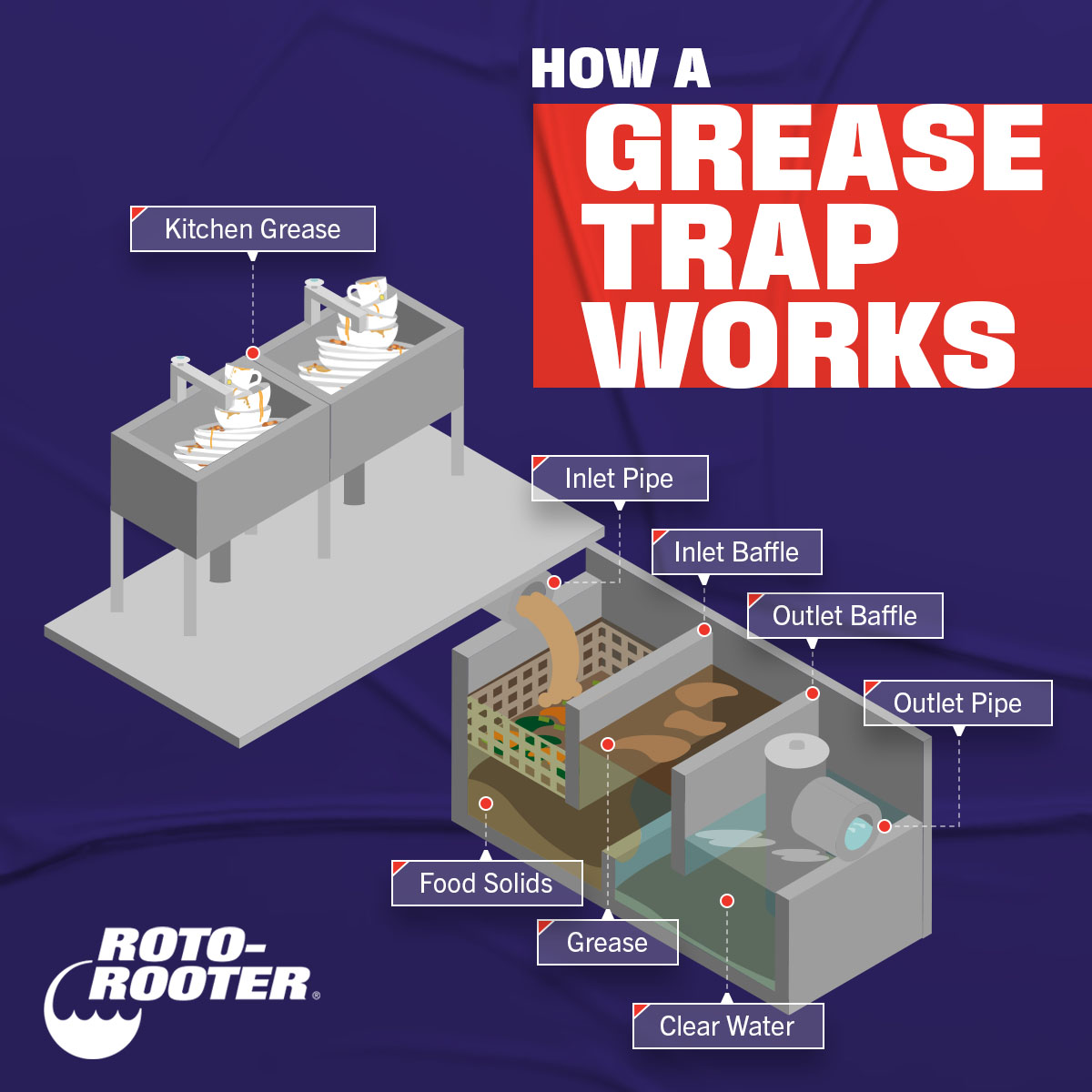
As the wastewater enters the trap, internal baffles - physical barriers built into the unit - immediately slow the flow. This is a critical step. Fast-moving water does not give FOG particles time to separate from the liquid. By slowing the flow dramatically, the trap creates the conditions needed for the natural separation process to take place. The water cools, the turbulence settles and the contents of the trap begin to organise themselves by density.
Step 3: Grease rises, solids sink
With the flow slowed and the water cooled, basic physics takes over. FOG is less dense than water, so it rises and forms a floating layer at the surface of the trap. Heavier food solids - scraps, sediment and debris - sink to the bottom and accumulate as sludge. The clarified wastewater sits in the middle layer, sandwiched between the grease above and the sludge below.
Step 4: Baffles retain the grease layer
The internal baffles that slowed the water on entry now serve a second purpose: they block the floating grease layer from passing through to the outlet pipe. Only the clarified water in the middle layer is allowed to flow out of the trap and into the municipal sewer system. This separation is the entire point of the device - and it only works correctly when the trap is not overloaded with accumulated FOG.
Step 5: FOG accumulates and must be removed
Grease traps do not dissolve or neutralise FOG. They collect and hold it. Over time - and depending on the volume and type of cooking, this can happen quickly - the grease layer thickens, the sludge layer deepens and the usable capacity of the trap shrinks. When the trap reaches capacity, FOG bypasses the baffles and flows directly into the drain pipes, defeating the purpose of the trap entirely. At that point, a clog or backup is not a matter of if - it is a matter of when.
Key Components Inside a Grease Trap
The step-by-step process above relies on several specific components working together. Here is what is happening inside the unit at each stage:
Flow Control
Wastewater enters the trap and is immediately slowed by the inlet baffle. This barrier forces the incoming flow to decelerate, giving the contents time to cool and begin separating by density. Without effective flow control, the separation process cannot occur - which is why damaged or corroded baffles are one of the most common causes of grease trap failure.
Separation
Once the flow is slowed, density differences do the work. Heavy solids drop to the bottom of the tank and form a sludge layer. Lighter FOG rises to the surface and forms the grease layer. The clarified water in between is the only material that should be leaving the trap through the outlet pipe.
Retention
The outlet baffle prevents the floating grease layer from escaping the trap and entering the sewer line. It acts as the last line of defence between your FOG waste and the municipal wastewater system. A functioning retention baffle is what keeps your kitchen compliant - a damaged one is what triggers FOG ordinance violations.
Maintenance
All of this only works if the trap is cleaned regularly. Most commercial kitchens require professional pump-outs every 30 to 90 days, depending on cooking volume, cuisine type and trap size. When FOG and sludge are not removed on schedule, the trap loses capacity, the separation process breaks down and grease bypasses the baffles directly into your drain lines.
Types of Grease Traps and Which Is Best for Your Business
Not all grease traps are the same. The right unit for your kitchen depends on the volume of cooking you do, the size of your facility and what your local sewer authority requires.
Passive Grease Trap
A passive grease trap is a compact, three-compartment unit typically installed under a kitchen sink or in the floor near a specific fixture. These units are smaller - usually with a capacity well under 100 gallons - and are best suited to lower-volume operations or individual fixture points rather than whole-kitchen drainage systems. They require more frequent cleaning than larger units because their capacity fills up faster. For a small café, a food truck fitting or a single prep sink in a lower-volume kitchen, a passive trap may be sufficient. For anything larger, a more robust solution is usually required.
Grease Recovery Device
A grease recovery device (GRD) automates the removal process. Rather than accumulating FOG until a pump-out is required, a GRD uses a mechanical skimming mechanism to remove the grease layer at timed intervals and deposit it into a separate collection container. This makes them particularly efficient in high-volume kitchens where FOG output is significant and consistent. The collected grease can often be recycled alongside waste vegetable oil from deep fryers - an environmentally responsible disposal option that is available at no cost in many areas. GRDs reduce the frequency of full pump-outs and can lower long-term maintenance costs, though they require a higher upfront investment.
In-Ground Grease Interceptor
An in-ground grease interceptor is a large-capacity system - typically 1,000 gallons or more - installed underground outside the building, usually serving the entire kitchen drainage system rather than individual fixtures. These units are the standard requirement for high-volume food service operations: large restaurants, hotel kitchens, cafeterias, hospitals and institutional food production facilities. Because of their size, they can go longer between cleanings than smaller units, but when they do require service, the job requires professional-grade vacuum equipment and licensed waste disposal. Your local sewer authority will specify whether your facility requires an interceptor rather than a standard under-sink trap.
How Is a Grease Trap Sized?
Grease trap sizing is not guesswork - it is typically determined by plumbing codes and local sewer authority requirements based on your kitchen’s output.
Sizing is influenced by several key factors:
- Flow rate (gallons per minute): The total volume of wastewater your sinks, dishwashers and fixtures produce determines how quickly the trap must process incoming flow.
- Fixture count and type: A kitchen with multiple prep sinks, dishwashers and floor drains generates significantly more FOG than a single-fixture setup.
- Type of food preparation: High-fat cooking methods - frying, grilling and heavy oil use - increase FOG output and require larger capacity systems.
- Local regulations: Most municipalities specify minimum grease trap or interceptor sizes based on formulas tied to fixture flow rates and kitchen classification.
Installing an undersized unit leads to rapid overfilling, frequent backups and potential compliance violations. A properly sized grease trap ensures adequate retention time for FOG separation and reduces the frequency of required cleanings.
Why Grease Traps Are Critical for Commercial Kitchens
A grease trap is not just a compliance checkbox - it is an active line of defence against some of the most disruptive and expensive problems a food service business can face.
Drain backups and foul odors
When a grease trap reaches capacity and FOG begins bypassing the baffles, it enters the drain pipes directly. Grease cools and hardens quickly on pipe walls, providing a sticky surface that catches food particles and builds into increasingly stubborn clogs. The result is wastewater backing up through your sinks, floor drains and dishwasher - often at the worst possible moment. Decomposing FOG waste also produces hydrogen sulfide gas, which generates the rotten-egg smell that permeates kitchens and dining areas when maintenance has fallen behind.
Sewer line blockages
FOG that escapes your drain pipes enters the municipal sewer system, where it combines with other waste materials and solidifies into large-scale blockages. These are not just your problem - they affect entire neighbourhoods and attract serious attention from local sewer authorities. Restaurants found responsible for contributing to sewer line blockages face FOG ordinance violations that carry significant fines, with escalating penalties for repeat offenders.
Health violations and shutdowns
An overflowing or foul-smelling grease trap is a direct health code violation. Health inspectors treat these odors as indicators of unsanitary conditions in the food preparation environment and a failing inspection score can mean mandatory remediation, re-inspection fees and reputational damage that is difficult to recover from. In serious cases of non-compliance, local authorities can suspend a restaurant's operating permit - meaning the business cannot legally open until the issue is fully resolved and documented.
Expensive emergency plumbing repairs
Routine grease trap cleaning is a predictable, budgetable expense. Emergency drain clearing - hydro-jetting or mechanical augering of a badly clogged commercial drain line - is not. Add the potential cost of baffle replacement, interceptor repair, pest control for an established infestation and lost revenue from a forced mid-service shutdown and the cost of neglect vastly outweighs the cost of staying on schedule.
FAQs About Grease Trap Function and Maintenance
How do I know if my grease trap is full?
The most reliable approach is to follow a cleaning schedule set by your service provider. Between visits, watch for slow-draining sinks or floor drains, a persistent sulfur or rotten-egg smell coming from the drains, wastewater backing up into fixtures or visible grease near drain openings. Any of these signs indicate the trap needs attention before a full backup occurs.
Does a grease trap always have water in it?
Yes. A properly functioning grease trap always contains water. The water layer is what enables the separation process - FOG floats above it, solids sink below it and clarified water in the middle flows out to the sewer. A trap with no water is not functioning correctly.
Can I use a grease trap in a home kitchen?
Small passive grease traps are available for residential use and can be useful for households that cook large quantities of fatty or fried foods regularly. They are not a standard residential requirement but can prevent drain problems for high-use home kitchens.
Are grease traps required by law in restaurants?
In most jurisdictions, yes. Local plumbing codes and FOG ordinances require commercial food service facilities to install a properly sized grease trap or interceptor and maintain it on a documented schedule. Failure to comply can result in fines, mandatory corrections at the restaurant's expense or suspension of the facility's sewer connection permit. Requirements vary by municipality - contact your local sewer authority for the specific rules that apply to your operation.
Where does the grease from a grease trap go?
Grease trap waste - a combination of FOG, food solids and wastewater - is classified as liquid waste and must be transported to a licensed, approved waste receiving facility. It cannot legally be disposed of in a standard dumpster, poured down a drain or deposited on land. In many areas, waste cooking grease can be processed into biofuel - a responsible disposal option that is often available at no cost.
Keep Your Grease Trap Working - Call Roto-Rooter
A grease trap that is not cleaned on schedule is not protecting your kitchen - it is a backup waiting to happen. Roto-Rooter's experienced plumbing technicians handle the full service: inspection, pump-out, component cleaning and licensed waste disposal, so you stay compliant and operational without the guesswork.
Roto-Rooter provides professional grease trap cleaning, maintenance and pumping services for commercial kitchens of all sizes. Schedule your grease trap service online or call Roto-Rooter 24/7, 365 days a year for urgent situations.