Green Plumbing
Rising utility bills push more households to look closely at every drop and every watt running through the home. Water and sewer rates have climbed steadily in most U.S. cities, and heating water alone accounts for roughly 18% of a typical household's energy bill. Green plumbing offers a direct way to shrink both numbers at once.
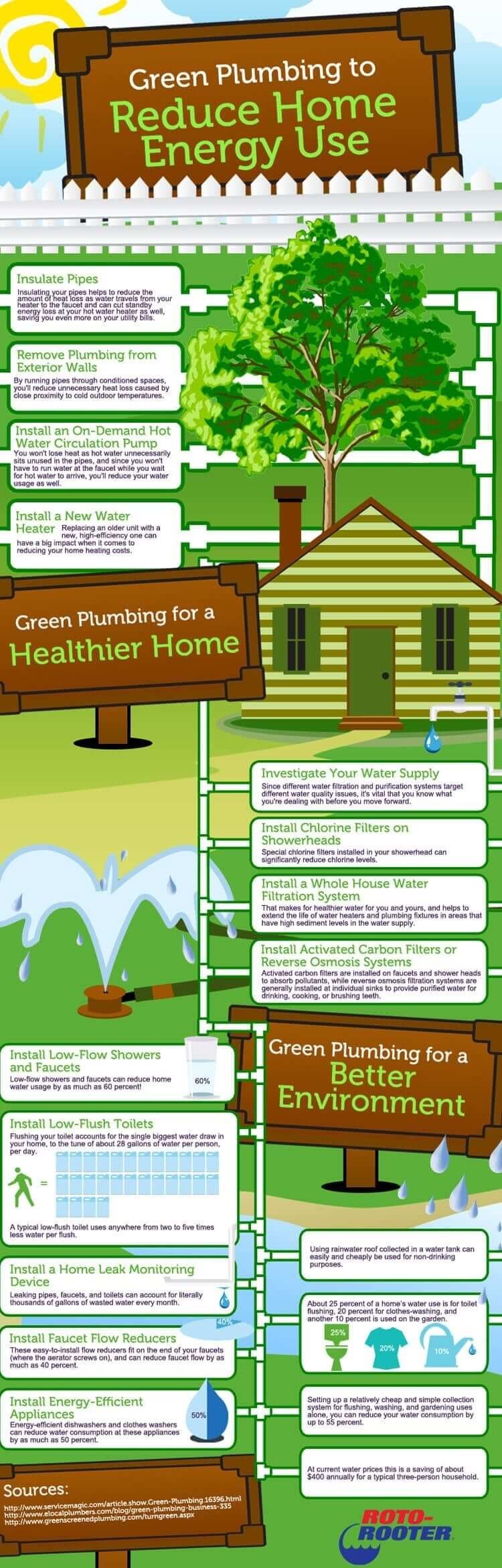
Green plumbing refers to the fixtures, appliances, and system upgrades that cut water consumption and reduce the energy needed to heat, pump, and treat that water. The payoff shows up twice on every utility statement: lower gallons used and less electricity or gas burned. Roto-Rooter's plumbers install these upgrades in homes across the country, and the three data points below come straight from the Roto-Rooter green plumbing infographic.
Three green plumbing upgrades that move the utility bill
The infographic highlights fixture swaps and appliance changes that deliver the largest savings for a typical household. These upgrades are listed below.
- Low-Flow Showerheads and Faucets: Swapping older fixtures for low-flow showerheads and faucets reduces water use at those fixtures by 60%, according to the Roto-Rooter infographic. EPA WaterSense labeled showerheads cap flow at 2.0 gallons per minute instead of the older 2.5 gpm standard, and the EPA estimates the average family saves 2,700 gallons of water and 330 kilowatt-hours of electricity each year after a single showerhead swap.
- Low-Flush Toilets: Toilet flushing is the single biggest water draw inside most homes, using about 28 gallons of water per person per day. A low-flush toilet uses two to five times less water per flush than an older model, according to the Roto-Rooter infographic. Federal standards cap new toilets at 1.6 gallons per flush, and WaterSense labeled models drop that number to 1.28 gallons or less.
- Energy-Efficient Appliances: Energy-efficient dishwashers and clothes washers reduce water use at those appliances by as much as 50%, per the Roto-Rooter infographic. Clothes washing alone accounts for about 20% of indoor household water use, so a certified washer trims both the water bill and the hot water heating load at the same time.
Roto-Rooter's plumbing technicians also recommend pairing fixture swaps with three system-level upgrades: insulated hot water pipes, a tankless or high-efficiency water heater, and a whole-house leak monitor. Insulating hot water pipes reduces standby heat loss, and a tankless water heater is 24% to 34% more energy-efficient than a conventional storage tank in homes that use 41 gallons or less of hot water per day, according to the U.S. Department of Energy. A leak monitor catches the slow drips behind walls that quietly add gallons to every bill.
Frequently asked questions about green plumbing
How much can a homeowner save each year by switching to water-saving fixtures?
A full fixture upgrade saves roughly $75 to $150 per year on water and heating costs for a low-flow showerhead alone, and a complete bathroom retrofit with WaterSense toilet, faucet, and showerhead saves about $60 per year in utility bills. Larger households with older fixtures often see bigger reductions because the baseline use is higher. EPA data shows a typical family saves 13,000 gallons of water per year after swapping to WaterSense labeled toilets, which drops the water bill and the sewer bill at the same time.
What is the EPA WaterSense label and why does it matter?
WaterSense is a voluntary EPA certification that guarantees a product uses at least 20% less water than the federal minimum while performing as well as or better than a standard model. The label appears on showerheads, faucets, toilets, irrigation controllers, and whole-home certifications. A WaterSense certified home is verified to use at least 30% less water than a comparable new-construction home built to standard code. Look for the label on the box or the product spec sheet before buying.
Is a tankless water heater worth the cost for an eco-friendly home?
A tankless water heater cuts water heating energy use by 24% to 50% depending on household size, because it heats water on demand instead of holding 40 to 80 gallons hot around the clock. Installation costs more upfront than a standard tank, but the average unit lasts about 20 years compared to 10 to 15 years for a tank heater. Roto-Rooter's plumbers install both electric and gas tankless models, and the right choice depends on simultaneous hot water demand in the house. A household running a shower and a dishwasher at the same time may need a larger unit or a second point-of-use heater to keep up.
Do low-flow showerheads actually give enough water pressure?
Modern low-flow showerheads use air injection and pressure-compensating technology that produces a shower feel similar to older 2.5 gpm fixtures. The early 1990s low-flow models earned a poor reputation because of weak spray and slow rinse times, and that reputation has stuck around longer than the actual hardware. Current WaterSense labeled showerheads pass independent third-party performance testing for spray force and coverage before earning the label.
What other green plumbing upgrades reduce home water use?
A rainwater collection system, a whole-house leak monitor, and faucet flow reducers each cut water use without replacing major fixtures. Rainwater collected from a roof into a storage tank is suitable for landscape irrigation and other non-drinking uses, and the Roto-Rooter infographic notes that a simple rainwater and greywater collection setup can reduce household water consumption by up to 55%. Faucet flow reducers cost a few dollars each and drop flow rates to about 1.5 gpm at kitchen and bathroom sinks. A Wi-Fi leak monitor tied to the main supply line catches pinhole leaks and running toilets that otherwise run up a bill unnoticed.
How does green plumbing affect home resale value?
Certified water-efficient homes and WaterSense labeled fixtures attract buyers looking for lower operating costs, and a whole-home WaterSense certification is a marketable feature in drought-prone markets. Appraisers do not always assign a line-item dollar value to every fixture, but a recent high-efficiency water heater, a tankless system, or a new set of low-flow fixtures shows up as a positive note on home inspection reports. Roto-Rooter's experienced plumbing technicians document upgrades with model numbers and flow ratings so homeowners keep a clear paper trail for future sale.
Green plumbing is not a single product, it is a set of choices that compound. A low-flow showerhead saves water. A tankless heater saves gas or electricity. A leak monitor catches the hidden gallons. Stacked together, these upgrades cut the water bill, trim the energy bill, and reduce the load on municipal water systems at the same time. Roto-Rooter is fully licensed and insured, trusted since 1935, and the company's plumbers install every fixture and system in this guide as part of standard residential service.
Loading customer reviews...